|
Key Takeaways:
|
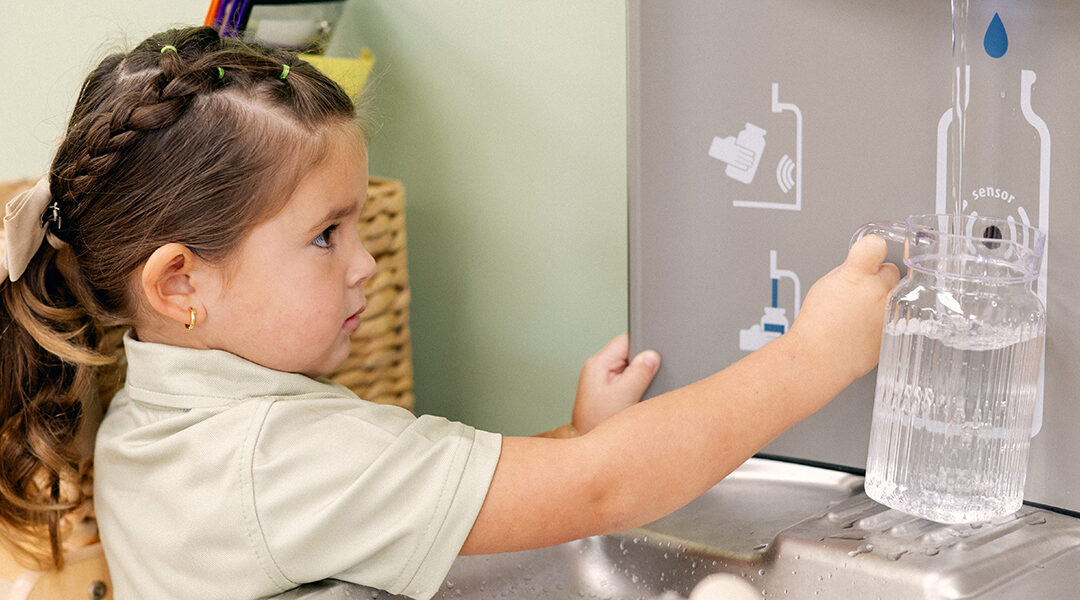
If you have spent time comparing preschool and early elementary programs, you have probably noticed that Montessori classrooms look different at first glance. Children pour water between pitchers, sweep floors, and button clothing frames while educators observe quietly nearby.
To parents accustomed to worksheets and group instruction, these scenes raise a fair question: Is this effective learning? It is. Practical life activities for Montessori students are among the most thoroughly researched and developmentally sound elements of the Montessori method.
This post explains what practical life work is, why it matters, and how each category supports your child’s growth.
How Montessori Education in Miami Lakes, Florida, Builds a Foundation for Lifelong Learning
Montessori education centers the child as an active participant in their own development, prioritizing:
- Independence
- Hands-on exploration
- Individualized pacing
This philosophy supports early cognitive growth, social confidence, and a love of learning that carries a child into a healthy life well beyond the classroom. Families considering Montessori education in Miami Lakes, Florida, will find that this approach cultivates flexible, self-directed learners who build genuine competence through purposeful daily work.
What Places Practical Life Activities at the Heart of Montessori Learning?
Practical life activities form the bedrock of the Montessori early childhood classroom because they address how young children learn best.
Dr. Maria Montessori recognized that children have a deep drive to imitate meaningful adult work, and when they channel that drive into real, purposeful tasks, they become more independent as they develop concentration and coordination.
Early experiences promoting self-regulation and motor development build the neural pathways essential for later academic success. A practical life curriculum translates these insights into structured everyday activities adapted to each child’s developmental stage.
Unlike simulated play with plastic toys, developing practical life skills involves authentic materials and real outcomes:
- Water actually pours
- Tables actually get clean
- Clothing actually fastens
That physical authenticity provides children with genuine feedback and builds real-world competence.
How Do Fine Motor Skills Develop Through Practical School Life?
Fine motor skill development is one of the most visible outcomes of Montessori practical life work. Through repetitive, controlled movements, children strengthen the small muscles of their hands and fingers in preparation for writing and mathematical tasks.
Common activities that build fine motor strength include:
- Transferring beans with a spoon or tongs
- Threading beads onto a lace
- Using droppers or pipettes to move water between containers
- Buttoning, snapping, and zipping dressing frames
- Folding cloths with precision
Fine motor development associates strongly with early literacy and academic readiness because these skills support handwriting, tool use, and visual-motor integration.
Montessori classrooms deliberately develop this progression, starting with simple scooping before advancing to tying bows or using child-safe knives. Each step in that sequence also reinforces hand-eye coordination, strengthening the visual and motor systems simultaneously and preparing children for reading and writing.
What Do Independence and Self-Care Activities Teach Beyond the Obvious?
Independence and self-care activities form the first category of the Montessori practical life curriculum, and their impact extends beyond hygiene and dressing routines. When a child learns to put on a jacket or prepare a simple snack independently, they internalize a powerful message: “I am capable.”
Practicing age-appropriate responsibilities strengthens autonomy and problem solving while improving emotional resilience. Montessori classrooms support this by designing the environment at the child’s scale:
- Low sinks
- Child-sized furniture
- Accessible shelves
- Real tools sized for small hands
The shift from dependence to initiative builds confidence and problem-solving skills that transfer into academic work and social situations.
How Does Care of the Environment Build Responsibility and Community Awareness?
Care of the environment, one of the four practical life categories, teaches children to maintain their shared surroundings with intention. Activities centered on organizing the classroom include watering plants and sweeping floors, with every task reinforcing the understanding that individuals contribute meaningfully to a shared community.
Children who help with everyday family jobs (like chores) when they’re young tend to grow up feeling more responsible and getting along better with others.
In Montessori classrooms, these kinds of tasks aren’t forced “chores” that kids have to do as punishment. Instead, children pick them freely because the activities feel real, useful, and exciting. When students feel that they’re making a real difference and helping out in a meaningful way, they naturally feel capable and proud of themselves.
Why Are Grace and Courtesy Lessons Essential to the Montessori Practical Life Curriculum?
The social skills built around grace and courtesy as part of Montessori practical life address something many programs overlook. The program focuses on deliberate, proactive teaching of respectful and considerate behavior.
Lessons in this category include:
- Greeting classmates with a handshake or a polite nod
- Offering help to a peer who is struggling
- Waiting patiently for a turn with a material
- Interrupting a conversation politely when necessary
Rather than correcting children after social missteps, educators model appropriate behavior in advance through brief, clear demonstrations. Early instruction in cooperation and emotional regulation supports academic success and positive peer relationships.
This approach gives children the language and habits of courtesy before they need them. The result is a classroom where conflict decreases not because rules are enforced, but because children genuinely understand how to treat one another with care.
How Does Control of Movement Support Concentration and Academic Readiness?
Control of movement, the fourth practical life category, trains children to move deliberately and with full attention. Activities include:
- Carrying trays without spilling
- Walking carefully around classroom rugs
- Pouring liquids with precision
These exercises address a foundational principle of early childhood neuroscience: movement and cognition are deeply connected. Coordinated movement and sensory experiences build the neural networks associated with higher cognitive functions. Montessori classrooms develop concentration naturally by weaving movement into learning rather than suppressing it.
Children in traditional settings often receive the message that sitting still equals learning. Montessori inverts that assumption. A child who practices carrying a tray carefully builds the same attentional strength they will later use when working through a complex math problem or a reading exercise, and they build it through the body, not in spite of it.
Do Practical Life Activities Actually Prepare Children for Academic Work?
Yes, and the connection is direct. Research has shown that Montessori students often demonstrate stronger executive function and social skills than peers in traditional programs.
Much of that advantage traces back to early practical life experiences. Here is how each practical life area connects to academic readiness:
| Practical Life Area | Academic Benefit |
| Fine Motor Work | Supports handwriting and use of mathematical materials |
| Care of Self | Builds independence and reduces anxiety in new learning situations |
| Care of Environment | Develops responsibility and sustained attention |
| Grace and Courtesy | Supports cooperative learning and conflict resolution |
| Control of Movement | Strengthens concentration and executive function |
Practical life work also builds the ability to plan a multi-step task, execute it in sequence, and evaluate the result. These are not soft skills that fade with time.
Parents often notice the transfer at home first. A child who returns materials to their shelf at school begins organizing their room the same way, without being asked. The habits formed in practical life carry learning forward in every subject and setting.
How Do Practical Life Activities Evolve as Children Grow?
Practical life work adapts to match children’s developmental stages rather than remaining static.
At the toddler level, tasks center on basic independence:
- Carrying objects
- Simple pouring
- Returning materials to their proper place
In the primary years (ages 3 to 6), activities become more complex:
- Food preparation
- Sewing and threading
- Full grace and courtesy lessons
At the elementary level, practical life expands into community responsibility through:
- Gardening
- Cooking projects
- Collaborative planning
Mixed-age classrooms amplify this progression further. Older children naturally model practical life skills for younger ones, reinforcing their own mastery while giving younger students a relatable example from a peer group.
This natural progression ensures children always encounter work that challenges them appropriately without overwhelming them, sustaining the intrinsic motivation that makes Montessori learning durable.
Give Your Child a Strong Start at Montessori Children’s House of Miami Lakes
The dedicated guides at Montessori Children’s House of Miami Lakes combine an authentically prepared environment with a Christian-values foundation to offer child development activities that support every dimension of your child’s growth.
From practical life work that builds real, lasting competence to a curriculum honoring each child’s unique pace, the team at Montessori Children’s House of Miami Lakes is ready to partner with your family.
To learn more about the value of practical life activities for Montessori students or to schedule a tour of our school, call (305) 823-5632 or contact us online today.