Typing “Montessori preschools near me” gives you dozens of options in Miami Lakes. The challenge is knowing which ones truly follow Montessori principles and which ones only use the label.
This guide gives you a practical, on-the-ground checklist you can use during school tours, calls, and comparisons. It focuses on what you can observe, ask, and verify—so your decision is based on clarity, not guesswork.
A Smarter Way to Evaluate Montessori Schools
Instead of relying on brochures or websites, use three filters:
- What you see (classroom, children, materials)
2. What you hear (teacher language, tone, guidance)
3. What you’re told (curriculum, training, philosophy)
When all three align, you’re likely looking at a strong Montessori program.
The Parent Tour Checklist (Use This in Real Time)
Bring this with you—or keep it on your phone—and score each school as you go.
1. Classroom Flow: Are Children Deeply Engaged?
Watch for 10–15 minutes without interruption.
You should notice:
- Children choosing work independently
- Long periods of concentration
- Minimal teacher interruption
- Quiet, purposeful movement
If most children are waiting, wandering, or being directed constantly, that signals a less authentic environment.
2. Materials: Are They Purposeful and Complete?
Montessori materials are precise and sequential.
Look closely:
- Are materials arranged from simple to complex?
- Are there complete sets (not random toys)?
- Do children repeat activities without being rushed?
Materials should guide learning—not entertain.
3. Teacher Role: Guide or Instructor?
Listen carefully to how teachers interact.
Strong signs:
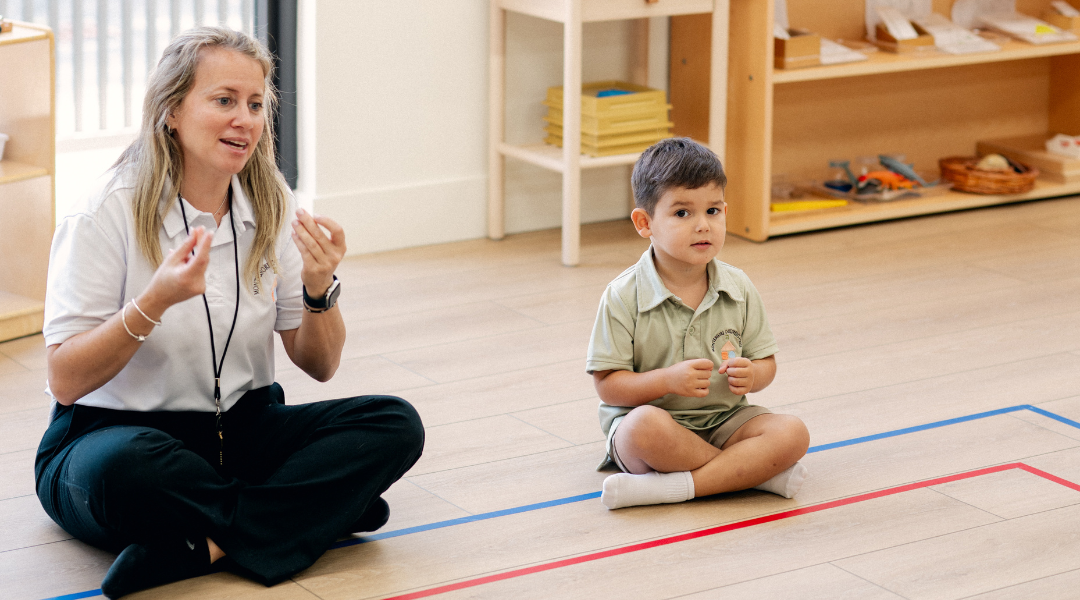
- Teachers kneel or sit at the child’s level
- They give short, clear lessons
- They observe more than they talk
- They redirect calmly without raising their voice
Ask yourself: Is the adult controlling the room, or supporting it?
4. Independence in Action
Independence should be visible everywhere.
Look for:
- Children cleaning up spills on their own
- Pouring, serving, and organizing materials
- Choosing when to start and finish work
- Managing small challenges without immediate adult help
These are not extras—they are core outcomes of Montessori education.
5. Mixed-Age Community
Authentic Montessori classrooms group children across ages (typically 3–6).
Why this matters:
- Younger children learn by observing
- Older children reinforce skills by helping
- Social development becomes more natural
If all children are the same age, ask why.
6. Work Cycle Length
Montessori relies on uninterrupted work periods.
Ask directly:
- “How long is your morning work cycle?”
Look for:
- 2–3 hours of uninterrupted time
- No constant transitions or rotations
- Children free to stay with one activity as long as needed
Frequent interruptions break concentration and limit learning depth.
7. Discipline Approach: What Happens When Things Go Wrong?
Instead of asking if discipline exists, ask how it works.
Listen for:
- Redirection instead of punishment
- Conflict resolution coaching
- Emotional awareness and language
Avoid environments that rely heavily on:
- Time-outs as a primary tool
- Rewards and punishments for behavior control
8. Academic Readiness Without Pressure
Montessori classrooms include early literacy and math—but not through drills.
Look for:
- Hands-on math materials (beads, counting tools)
- Phonics-based reading foundations
- Children progressing at different levels
Ask:
- “How do you support a child who is ahead or needs more time?”
9. Parent Communication and Transparency
You should feel informed, not uncertain.
Ask:
- How often do you receive updates?
- Are conferences scheduled regularly?
- Can parents observe classrooms?
Strong schools welcome informed parents.
This checklist is based on what experienced Montessori educators and school leaders look for during classroom observations.
What Makes Montessori Children’s House of Miami Lakes Different
At Montessori Children’s House of Miami Lakes, the focus is on developing the whole child within a structured, respectful environment.
Miami Lakes families value:
- A calm, secure classroom setting
- A balance of independence and guidance
- A spiritually enriched atmosphere
- Leadership that supports both children and parents
The goal is consistent: help each child build confidence, overcome challenges, and develop a lasting love of learning.
A Better Way to Compare Local Montessori Preschools
Instead of asking “Which school is best?”, compare schools using the same criteria.
Create a simple scoring system (1–5) for each category:
- Engagement
- Environment
- Teacher interaction
- Independence
- Communication
After visiting 2–3 private Montessori preschools near me, patterns become clear quickly.
FAQs When Choosing the Best Montessori Preschool in Miami Lakes
What should I look for during a Montessori preschool tour?
Focus on real classroom dynamics instead of presentations. Observe whether children are engaged, choosing their own work, and concentrating for extended periods. Pay attention to how teachers interact—short lessons, calm tone, and minimal interruption are strong indicators of authentic Montessori practice. Also, evaluate whether materials are organized, complete, and used with purpose.
How can I tell if a Montessori preschool in Miami Lakes is authentic?
Authentic programs follow specific principles: mixed-age classrooms, uninterrupted work cycles, and hands-on materials designed for self-directed learning. Teachers act as guides rather than instructors. If the classroom relies heavily on group instruction, worksheets, or constant direction, it likely does not fully implement Montessori methods.
Are private Montessori schools near me worth the cost in Miami Lakes?
Private Montessori schools often provide smaller class sizes, individualized learning, and carefully prepared environments that support independence and focus. For many families, the long-term benefits—confidence, self-discipline, and a love of learning—justify the investment. The value depends on how faithfully the Montessori approach is implemented.
How early should I enroll my child in a Montessori preschool?
Most Montessori programs begin the primary cycle between ages 2.5 and 3 years. However, at Montessori Children’s House of Miami Lakes, we recognize that the “sensitive periods” for language and order begin much earlier. That’s why we offer specialized environments for children as young as 15 months. Enrolling early allows your child to build a foundation of emotional security and physical independence before they even reach the primary classroom.
Explore a Montessori Option in Miami Lakes
After visiting a few local Montessori preschools, many parents notice how much programs can vary. Seeing a classroom in action helps those differences become clear—especially when you understand how programs are structured by age.
If you’re exploring options, consider visiting a Montessori preschool in Miami Lakes, where learning is tailored to each stage:
- Exploratory Learners (15 months–2 years): Focus on sensory exploration, language development, and early independence through hands-on activities.
- Young Imagineers (3–5 years): Emphasis on concentration, independence, early academics, and social skills during key developmental periods.
Observing both levels in person helps you better understand how Montessori supports your child’s growth over time.
Schedule a Tour and Evaluate With Confidence
The most effective way to choose the best Montessori preschool is to experience it directly—with the right checklist in hand.
Montessori Children’s House of Miami Lakes welcomes families who want a clear, transparent view of how children learn and grow in a Montessori setting.
Address: 6381 Miami Lakeway N, Miami Lakes, FL
Phone: (305) 823-5632
Schedule your tour today and use this checklist to make a confident, informed decision. Contact us to get started.