Choosing a preschool often feels like choosing the direction of your child’s entire educational future. Parents in Miami Lakes, Palm Springs North, and surrounding communities frequently ask the same question: Should I choose Montessori or a traditional preschool?
The answer depends on how your child learns, how they respond to structure, and what type of environment helps them feel confident and engaged.
Some children thrive in teacher-led classrooms with consistent group instruction. Others flourish when given independence, movement, and hands-on learning opportunities. Understanding the difference between Montessori and traditional preschool can help you make a decision that supports your child right now—not just academically, but emotionally and socially as well.
At Montessori Children’s House of Miami Lakes, the focus is on nurturing the whole child through independence, respect, concentration, and purposeful exploration in a calm learning environment inspired by authentic Montessori philosophy.
What Is the Difference Between Montessori and Traditional Preschool?
Montessori preschool focuses on child-led, hands-on learning with mixed-age classrooms and individualized pacing, while traditional preschool typically follows teacher-directed instruction, fixed schedules, and group-based activities. Montessori environments emphasize independence, concentration, and self-motivation, whereas traditional classrooms often prioritize structured lessons and uniform learning milestones.
The difference becomes visible the moment you walk into each environment.
In many traditional preschool classrooms, children rotate together through teacher-planned activities. Everyone may work on the same craft, practice the same letter, or participate in the same lesson simultaneously.
A Montessori classroom looks different.
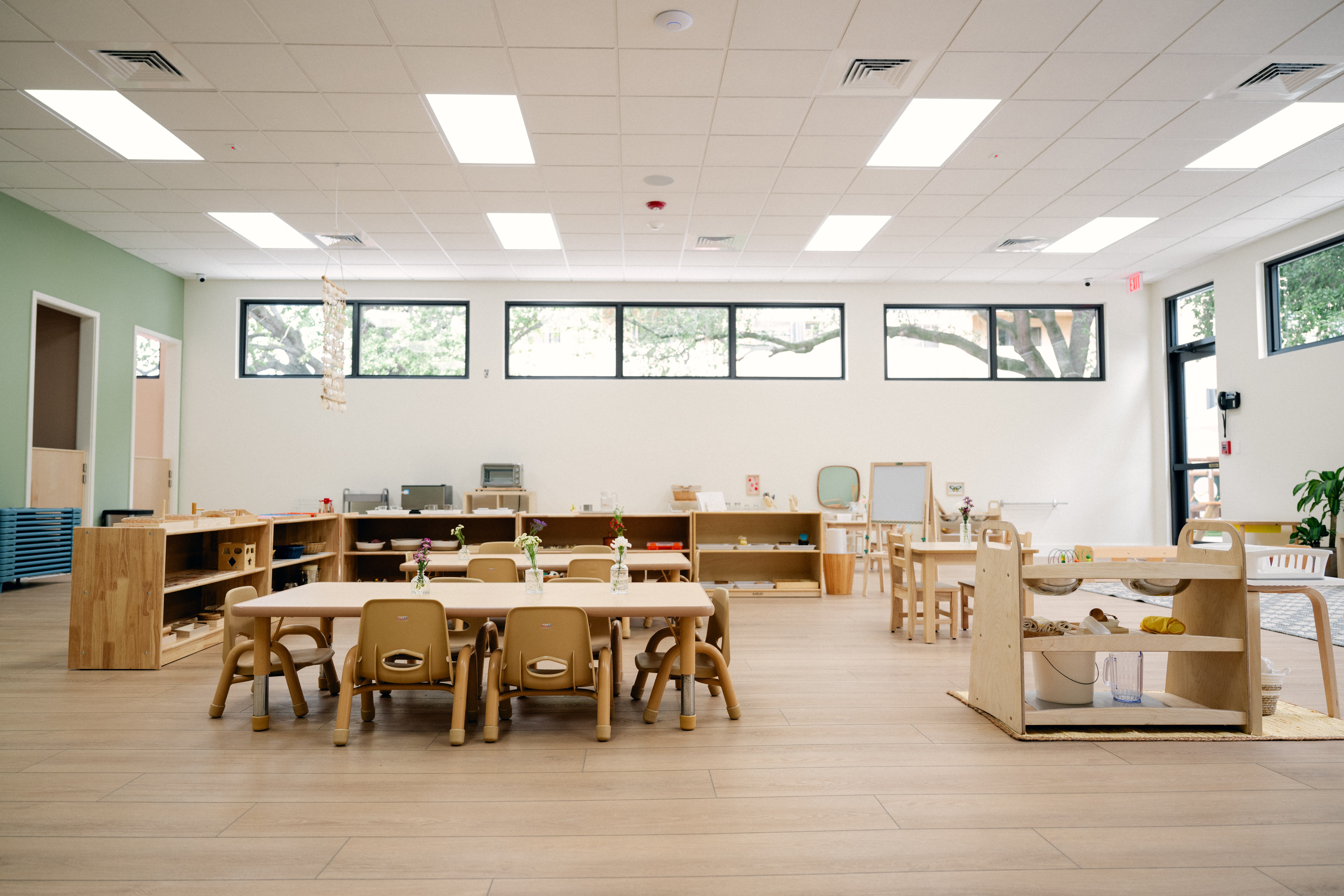
Children move independently throughout the room, selecting purposeful materials designed to build academic, social, and practical life skills. One child may be working with numbers, another practicing pouring exercises, while another reads quietly with a teacher nearby offering individualized guidance.
According to the American Montessori Society, Montessori education is designed to support natural child development through self-directed activity, collaborative play, and hands-on learning experiences.
Key distinctions include:
| Montessori Preschool | Traditional Preschool |
| Child-led learning | Teacher-led instruction |
| Mixed-age classrooms | Same-age classrooms |
| Hands-on materials | Worksheets and group activities |
| Individual pacing | Standardized pacing |
| Focus on independence | Focus on classroom routines |
| Long uninterrupted work periods | Frequent transitions |
For families near Main Street, Miami Lakes, Royal Oaks, or around Graham Dairy Lake Park, observing both classroom styles in person often makes the differences immediately clear.
Is Montessori Better for Every Child?
Montessori preschool is not automatically better for every child, but it can be highly effective for children who benefit from independence, movement, hands-on learning, and individualized pacing. Traditional preschool may work better for children who prefer highly structured group instruction and constant teacher direction.
No single educational model fits every child perfectly.
A highly active child who struggles sitting still during long group lessons may thrive in Montessori because movement is integrated into learning. A naturally curious child who enjoys exploring topics deeply may also excel in a Montessori environment where concentration is protected instead of being interrupted every 15 minutes.
On the other hand, some children initially feel more comfortable in predictable teacher-directed settings where expectations are highly structured throughout the day.
Parents should consider:
- How their child responds to independence
- Attention span during structured activities
- Comfort with social interaction
- Emotional regulation skills
- Curiosity and self-motivation
- Need for movement and sensory engagement
One misconception is that Montessori lacks structure. In reality, authentic Montessori classrooms are highly organized environments built around consistent expectations, carefully prepared materials, and freedom within clear limits.
At Montessori Children’s House of Miami Lakes, classrooms are intentionally designed to help children develop confidence while still receiving guidance and support from experienced educators.
How Does Learning Happen in a Montessori Preschool?
Montessori learning happens through hands-on exploration, repetition, observation, and self-correction using specially designed materials. Teachers guide children individually rather than delivering constant whole-group instruction, allowing children to develop independence, concentration, and intrinsic motivation.
Montessori classrooms are often described as “prepared environments.”
Everything in the room has a developmental purpose:
- Practical life activities build coordination and responsibility
- Sensorial materials strengthen observation and cognitive skills
- Language materials develop reading readiness
- Math materials introduce abstract concepts concretely
- Cultural lessons expose children to geography, science, and diversity
For example, instead of memorizing numbers from a worksheet, children physically manipulate counting materials to understand quantity and sequencing.
This approach aligns with research on experiential learning and early childhood cognitive development. According to the National Association for the Education of Young Children, young children learn best through active, meaningful engagement rather than passive instruction.
Montessori classrooms also reduce unnecessary interruption.
Children are encouraged to repeat activities until mastery develops naturally. That uninterrupted concentration is one reason many Montessori students develop strong problem-solving abilities and self-discipline at an early age.
Families searching for preschool programs in Miami Lakes often notice that Montessori students demonstrate independence in surprisingly practical ways—from cleaning up their workspace to resolving small social conflicts calmly.
Do Montessori Students Learn Academics Later?
Montessori students often learn academics differently, rather than later. Many Montessori children develop strong reading, math, and critical thinking skills early because concepts are introduced through hands-on materials and individualized pacing instead of standardized timelines.
This is one of the most common parent concerns.
Because Montessori classrooms may appear less rigid academically, some parents assume children are “just playing.” In reality, the materials are intentionally sequenced to introduce increasingly advanced concepts through exploration.
Children frequently develop:
- Strong phonetic awareness
- Early math comprehension
- Problem-solving skills
- Long-term concentration
- Independent thinking
- Internal motivation
A child working with tactile alphabet materials is developing foundational literacy skills, even if the lesson looks less formal than traditional desk work.
Montessori education also avoids excessive reward systems.
Instead of relying heavily on stickers, prizes, or public praise, children learn to experience satisfaction from mastery itself. Over time, this can support stronger intrinsic motivation and resilience.
In many traditional classrooms, academic readiness is measured by how well children follow group instruction. Montessori measures readiness differently: by observing mastery, curiosity, confidence, and developmental progression.
What Are the Social Benefits of Montessori Preschool?
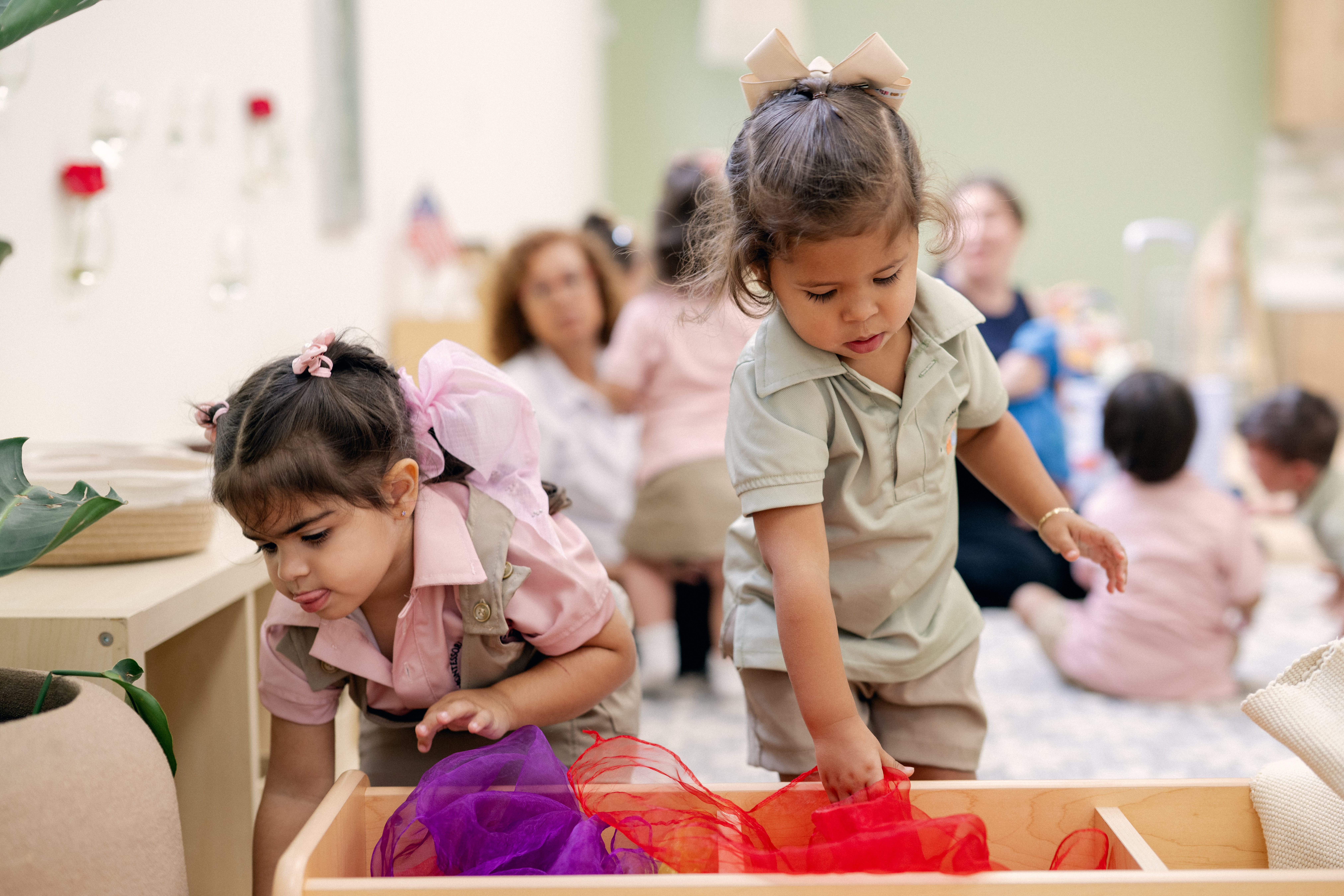
Montessori preschool supports social development by encouraging collaboration, emotional regulation, empathy, communication, and respect within mixed-age classrooms. Children learn social skills naturally through shared environments rather than constant adult intervention.
Mixed-age classrooms are one of the most unique features of Montessori education.
Younger children learn by observing older peers. Older children reinforce their own understanding by helping younger classmates.
This structure often encourages:
- Leadership skills
- Patience
- Conflict resolution
- Cooperation
- Confidence
- Respect for differences
Rather than competing constantly for teacher attention, children learn to function as part of a community. This can be especially beneficial for young children transitioning into school environments for the first time.
In fast-growing areas like Miami Lakes—where many families balance demanding schedules and busy routines—parents often value educational settings that reinforce independence and emotional stability alongside academics.
Children also tend to develop practical self-care skills earlier in Montessori environments because classrooms encourage active participation in maintaining the learning space.
How Can Parents Choose Between Montessori and Traditional Preschool?
Parents should choose between Montessori and traditional preschool by evaluating their child’s temperament, learning style, emotional needs, and the quality of the specific school environment—not just the educational label.
The school itself matters just as much as the philosophy.
A strong Montessori program should include:
- Trained Montessori educators
- Prepared classrooms
- Hands-on materials
- Child-led work periods
- Calm, organized environments
- Respectful teacher-child interactions
When touring schools, avoid focusing only on appearance or marketing language.
Instead, observe:
- Are children engaged independently?
- Do teachers redirect calmly?
- Is the classroom peaceful but active?
- Are materials accessible and purposeful?
- Do children appear confident and secure?
Parents touring schools near Miami Lakes Optimist Park or along Ludlam Road often say the classroom atmosphere tells them more than brochures ever could.
The best preschool environment is one where your child feels safe, respected, curious, and capable.
What Are Parents Really Looking For Today?
Today’s parents are increasingly looking for preschool environments that develop independence, emotional intelligence, adaptability, and real-world problem-solving skills—not just early academic performance.
Educational priorities have shifted significantly in recent years.
Many parents now recognize that long-term success depends on more than memorization or early testing performance. Skills like communication, resilience, concentration, and adaptability are becoming equally important.
That shift is one reason Montessori education continues growing in popularity across communities like Miami Lakes and greater Miami-Dade County.
Families are asking:
- Will my child enjoy learning?
- Will they build confidence?
- Will they learn how to think independently?
- Will school support their emotional development?
- Will they feel secure and motivated?
Montessori education was designed around many of these questions long before they became mainstream educational priorities.
Finding the Right Preschool Environment for Your Child
Every child develops differently, and the “best” preschool is ultimately the one that aligns with your child’s personality, learning style, and emotional needs.
Some children thrive in highly structured traditional classrooms. Others blossom in Montessori environments that encourage independence, exploration, and self-paced learning.
What matters most is finding a school where your child feels supported, engaged, and excited to learn each day.
At Montessori Children’s House of Miami Lakes, families experience a nurturing environment designed to support academic growth, confidence, emotional development, and a lifelong love of learning. Conveniently located at 6381 Miami Lakeway N, Miami Lakes, FL, the school serves families throughout Miami Lakes and nearby communities with a child-centered Montessori approach rooted in respect and purposeful learning.
Parents interested in exploring whether Montessori education is the right fit for their child can learn more about the school’s philosophy, programs, and classroom environment by calling (305) 823-5632 or scheduling a tour.