

The first drop-off is the hard part. We’ve watched thousands of parents linger at the classroom door, and we’ve watched thousands of children settle in faster than their parents expected. That gap — between what a parent fears will happen and what actually happens — is what this guide is for.
We’ve walked families through this exact transition for 53 years. This isn’t a general claim about Montessori education, but our own deeply rooted record here at Montessori Children’s House of Miami Lakes. While our school transitioned to new ownership in 2023, the collective wisdom, traditions, and community experience we rely on date all the way back to 1973.
Here’s what the first month genuinely looks like, week by week, along with a guide on what is perfectly normal versus what might be worth a conversation with your child’s guide (the Montessori term for teacher).
Week One: Orientation, Not Adjustment
The first week isn’t about your child adjusting to the classroom. It’s about the classroom adjusting to your child.
In a Montessori environment, a trained guide spends the early days observing before directing — watching where a child gravitates, how they handle transitions, what regulates them when they’re overwhelmed. We’ve seen children who cried at drop-off on Monday be fully absorbed in a practical life activity, like pouring or buttoning, by Thursday. We’ve also seen children who seem confident on day one and need more support by day three, once the novelty wears off. Both patterns are normal. Neither predicts how the month will go.
What we ask parents to expect in week one:
- Short, matter-of-fact goodbyes. Lingering tends to signal to a child that there’s something to worry about.
- Some resistance to structure, even in children who are naturally rule-followers at home. New environments test boundaries.
- Fatigue by the end of each day. Focused, independent work is genuinely tiring for young children in a way that unstructured play is not.
Week Two: The Work Cycle Starts to Click
By the second week, most children begin to understand the rhythm of the uninterrupted work cycle — the extended block of time where they choose activities from the prepared environment and work at their own pace. This is where Montessori’s core principle of freedom within limits becomes visible rather than theoretical: children choose their work, but within a structured, purposeful environment designed for their developmental stage.
We’ve found this is the point where separation anxiety, if it hasn’t resolved on its own, usually needs a specific intervention rather than just time. A modified arrival time, a preferred activity ready and waiting, or a guide staying closer during the first transition can make a measurable difference. (We track settling time — not just whether a child cries, but how quickly they move from distress into an activity — as the real signal of progress; more on that below.)
Week Three: Independence Starts Showing Up at Home
This is usually when parents start emailing us, unprompted, about things they’ve noticed at home: a four-year-old who suddenly wants to pour their own juice, a three-year-old insisting on putting away their own shoes. This isn’t a coincidence. Montessori’s emphasis on independence and respect for a child’s natural development is designed to transfer beyond the classroom, and by week three, it typically has.
It’s also common for children to test limits more at home than at school during this period — a sign they’re expending significant self-regulation energy in the classroom and have less left over by pickup. We tell parents this is a good sign, not a warning sign, provided it settles within a week or two.
Week Four: A New Baseline
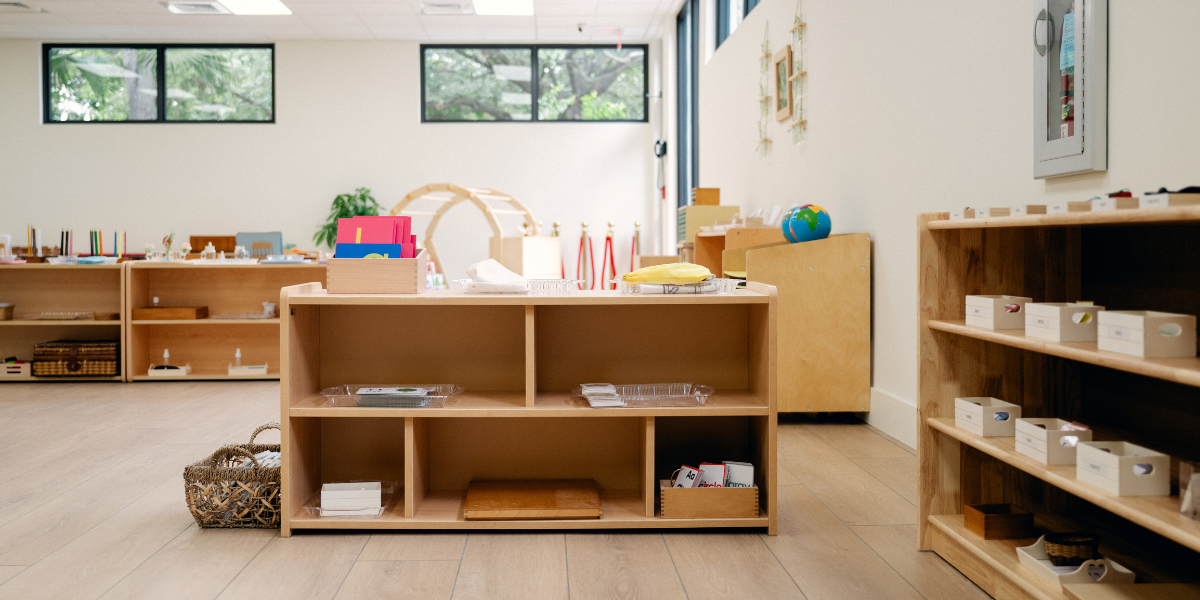
By the end of the first month, most children have a working understanding of the classroom’s rhythm: where materials live, how to request help, what happens during snack and outdoor time, and how transitions between activities work. This doesn’t mean the adjustment is finished — Montessori development happens in cycles, not a single completed transition — but it does mean the acute phase is typically over.
If your child is still having daily difficulty at drop-off, refusing most activities, or regressing in previously mastered skills by week four, that’s worth a direct conversation with the classroom team. It’s uncommon, but it happens, and it’s almost always solvable with a small adjustment rather than a major change.
What Makes This Transition Easier
A few things consistently make the first month smoother, based on what we’ve observed across decades of enrollments:
- Consistency between home and school. Children settle faster when the language and expectations at home echo what happens in the classroom, even loosely.
- Resisting the urge to over-explain. Long goodbye conversations tend to create more anxiety, not less.
- Trusting the observation period. The first few weeks are diagnostic for the guide. Frequent parent-initiated schedule changes during this window can actually slow things down.
- Choosing an environment built for this exact stage. A prepared environment, sized and paced for early childhood development, does a lot of the regulating work on its own.
Frequently Asked Questions
Is it normal for my child to cry every day for the first two weeks?
Yes, within limits, what matters is how quickly your child settles into an activity after drop-off, not whether the goodbye itself is tearful. Our guides track that settling time day over day. If it isn’t improving by day ten, that’s our marker for a classroom-side adjustment — a preferred activity ready and waiting, a shorter initial work period, or a guide staying closer during the transition — rather than assuming more time will fix it.
Should I stay in the classroom longer to ease the transition?
Generally, no. Lingering tends to signal to a child that there’s a reason to worry, which can extend the adjustment rather than shorten it. A brief, warm, consistent goodbye is almost always more effective than a drawn-out one, even though it feels counterintuitive to a parent.
My child seems fine at school but has meltdowns at home. Is that a bad sign?
It’s actually one of the more common and least concerning patterns we see. Children often spend significant self-regulation energy holding it together in a structured environment, and home becomes the safe place to release that. This usually settles within the first month as the classroom routine becomes second nature.
How will I know if the classroom is a good fit, versus my child just needing more time?
Time alone typically resolves resistance to routine, mild separation anxiety, and fatigue. What it doesn’t usually resolve is a child who, after three to four weeks, still refuses most activities, shows no interest in any classroom materials, or is regressing in previously mastered skills. That combination is uncommon, and it’s worth a direct conversation with the guide rather than assuming more time will fix it.
Can I request updates during the day if my child is struggling?
Most Montessori classrooms, including ours, prefer to give a child space to work through the transition during the day and provide a fuller update at pickup, rather than interrupting the observation period with frequent check-ins. If a child is in genuine distress, the guide will always reach out directly — you won’t be left wondering.
A Note on Why We Focus on This Stage
We’ve watched this exact transition play out with thousands of different children — anxious ones, confident ones, ones who surprised us either way. What stays consistent isn’t the child, it’s the process: a prepared environment, a guide trained to observe before intervening, and enough structure that a child’s own development does most of the settling-in work. That’s not a philosophy we’re reciting; it’s the reason the first month here tends to look the way this guide describes.
If you’re comparing options and want to see how a Montessori school in Miami Lakes handles this transition in practice, we welcome a visit. Our campus is at 6381 Miami Lakeway N in Miami Lakes, and our team is reachable at (305) 823-5632 if you’d like to talk through your child’s specific temperament before enrollment — every transition looks a little different, and we’d rather have that conversation early than after a difficult first week.